Why is it that life strategy and business strategy are the same thing?
- Dec 1, 2016
- 4 min read
Why have we been taught our whole lives that business and society are different concepts. Is there a common thread that links them? Organisations are innefficiently organised as departments and divisions. We are taught subjects of the same phenomena or concepts in silos at school. e.g. WWII could be studied from not only a historic perspective but a scientific and an economic perspective. Similarly there is a common denominator between business strategy and life strategy. That is purpose.
The key implications to strategy are vested in the purpose of business which is to perform economically and result in creating economic value. The strategy then becomes the "hammer to a nail" . Which in itself can be considered "tools for" innovation, technological or business model wise. It becomes interesting when paralleling this to you creating value for society and the extent to which you innovate yourself in other words, the extent to which you "grow" as person. How you do this becomes your life purpose, well that sounds like strategy to me.
Let us consider "Strategy" in the eyes of world renowned thought leader on the matter Dr Roger Martin, whom meeting was a surreal moment. He says "I'm a simple guy and I like to place complex concepts into simple, one sentence lines". "For me strategy is answering 5 simple questions":
"What are our broad aspirations for our organization & the concrete goals against which we can measure our progress?" (Martin, 2010) || As an individual, this is asking yourself. What is it that I want to DO with my life, not what do I want to HAVE in my life? How I see myself will determine who I become. This is what you can call, "vision". Then define what is success for you, within the context of "the vision". How will you know that you are that person? How will you feel when you are thy "best self".
"Across the potential field available to us, where will we choose to play and not play?"(Martin, 2010) || As an individual, you did not choose where to be born, or to whom, much of your early life is also not up to you. By now you have probably orientated yourself within an industry or have direction of interests and passions. This is your playground. Analyse it, understand it, find the gap and white spaces where your can paint your vision.
"In our chosen place to play, how will we choose to win against the competitors there?" (Martin, 2010) || As individual, you will understand the conventions.You will push boundaries to do the things that others are not willing to do. These will define your differentiating strategy, aligned to your passion.
"What capabilities are necessary to build and maintain to win in our chosen manner?" (Martin, 2010) || As individual, what are the traits and skills required to fulfill that innovative opportunity on your playground. How do you plan to innovate yourself. Which books do you fill your mind with, what conversations do you engineer your thoughts with, what experiences do you teach yourself with? Remember to answer with clear and concise focus on WHO, I want to be.
"What management systems are necessary to operate to build and maintain the key capabilities?" (Martin, 2010) || As an individual... One must understand that everything above, is in your mind. This is where the rubber hits the tar. The behaviors, the activity habits and more importantly thinking habits that will support everything above. What daily routines and lifestyle do you need to live by? Greatness is the sum of all small successes of everyday.
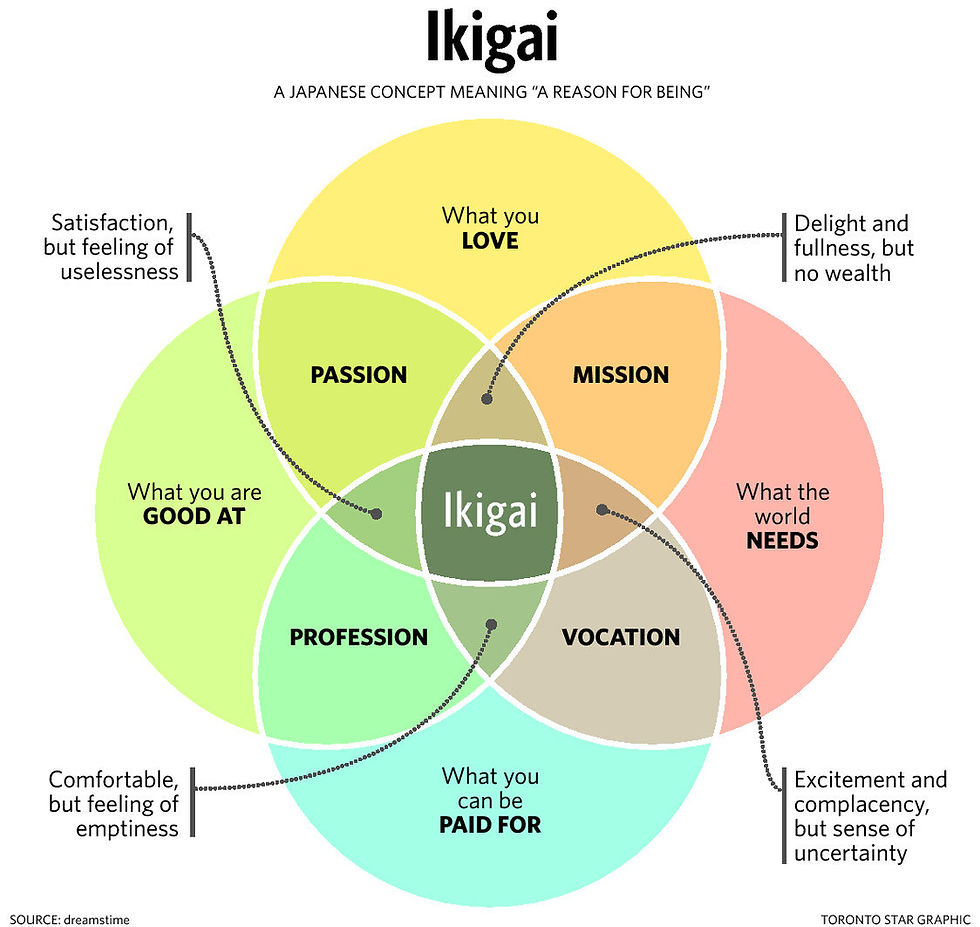
Forshay, global HR consulting firm and recruitment specialist adapt the following Venn diagram for one doing one's best work where by that work can be defined as your life purpose. You will easily begin to notice parallel's between your purpose and strategy.
This is a key insight, that jumps out at you and shouts: "If you do not think about what it is that you want to do with your life, if you do not begin to be deliberate about where you are going you will be like a ship with no destination. No matter how grand the ship, you will just drift around and round succumbing to the oceanic currents. However the more you ask yourself, these key critical questions, the more life begins to take on a life of its own. Life begins to feel much more bliss.
On an organisational level, you can begin to notice that, managers and business people can gain strategic value from adopting the division's, business's or team's purpose. Thereafter communicating it to the organisation juxtaposing the 5 questions above with the four questions below.
Individual Level Organisation Level
"What you love" =>> "What my employees have an inclination towards"
"What the world needs" =>> "What my market needs"
"What the world will pay for" =>> "What my market is willing to pay for"
"What you do well" =>> "My organisation's core competency"
Reference
Martin, R. (2010). Five Questions to Build a Strategy. Harvard Business Review, May. Retrieved from https://hbr.org/2010/05/the-five-questions-of-strategy


Comments